Real Estate Today marks one year at number one, after taking the top spot in just five months
To the Australian Real Estate Industry, Thank you.
Thank you for your support, your trust, your engagement, and for simply giving us a go.
Without you, we would not be here. That is something we recognise, and something we do not take lightly.
This platform was not built in isolation. It was built with the industry, shaped by it, challenged by it, and ultimately carried by the people within it who were ready for something different.
It has been a year defined by growth and innovation at Real Estate Today Australia.
But more importantly, it has been a year that revealed something deeper about the state of real estate media in this country.
Before the rankings, before the recognition, before the expansion, there was a simple premise.
The industry had stopped evolving.
Real Estate Today was launched on January 6, 2025, following early traction in New Zealand. It entered a market that, on the surface, appeared mature and well established. Multiple publications, long-standing brands, consistent output.
But underneath that, there was a growing disconnect.
The same voices were being amplified.
The same formats were being repeated.
The same recognition cycles were being reinforced.
What was missing was not content.
It was progression.
We didn’t need another media outlet recycling the same stories, says founder and CEO Nic Fren. We needed fresh thinking. Fresh energy. And a platform that actually reflected where the industry was going, not where it had been.
From the outset, Real Estate Today made a series of deliberate decisions that would ultimately define its trajectory.
It chose not to chase controversy.
It chose not to manufacture negativity.
It chose not to elevate individuals purely for attention.
Instead, it focused on building credibility through relevance.
That decision shaped everything that followed.
The launch of 25 Under 25 in 2025 was not simply a feature. It was a repositioning of who gets seen in this industry. It shifted attention away from established cycles of recognition and towards emerging talent, those growing up alongside AI, digital platforms and new forms of communication.
The introduction of the 60 second audio 'Morning Brief' created consistency, a daily rhythm that aligned with how professionals actually consume information.
Audio integration for our articles responded to behaviour, acknowledging that the industry does not always have time to read, but still wants to stay informed.
My RET introduced personalisation, shifting the experience from passive consumption to active engagement.
A live events calendar moved the platform beyond publishing into participation.
RET Intelligence marked a transition into insight, data and forward positioning.
Trailblazers Awards challenged long-standing credibility concerns by removing human judges entirely, introducing AI-led evaluation in an effort to eliminate bias.
More than 70 submissions were received in the first year, an early indicator that the appetite for change extended beyond readership.
And behind all of it, internal systems such as Xenova were developed to support infrastructure, efficiency and long-term growth.
Individually, each initiative represented progress.
Collectively, they represented a shift.
What emerged was not just a publication, but a platform that rethought how media could operate within the real estate industry.
And while that was being built, the market responded.
Within weeks of launch, Real Estate Today began to gain traction.
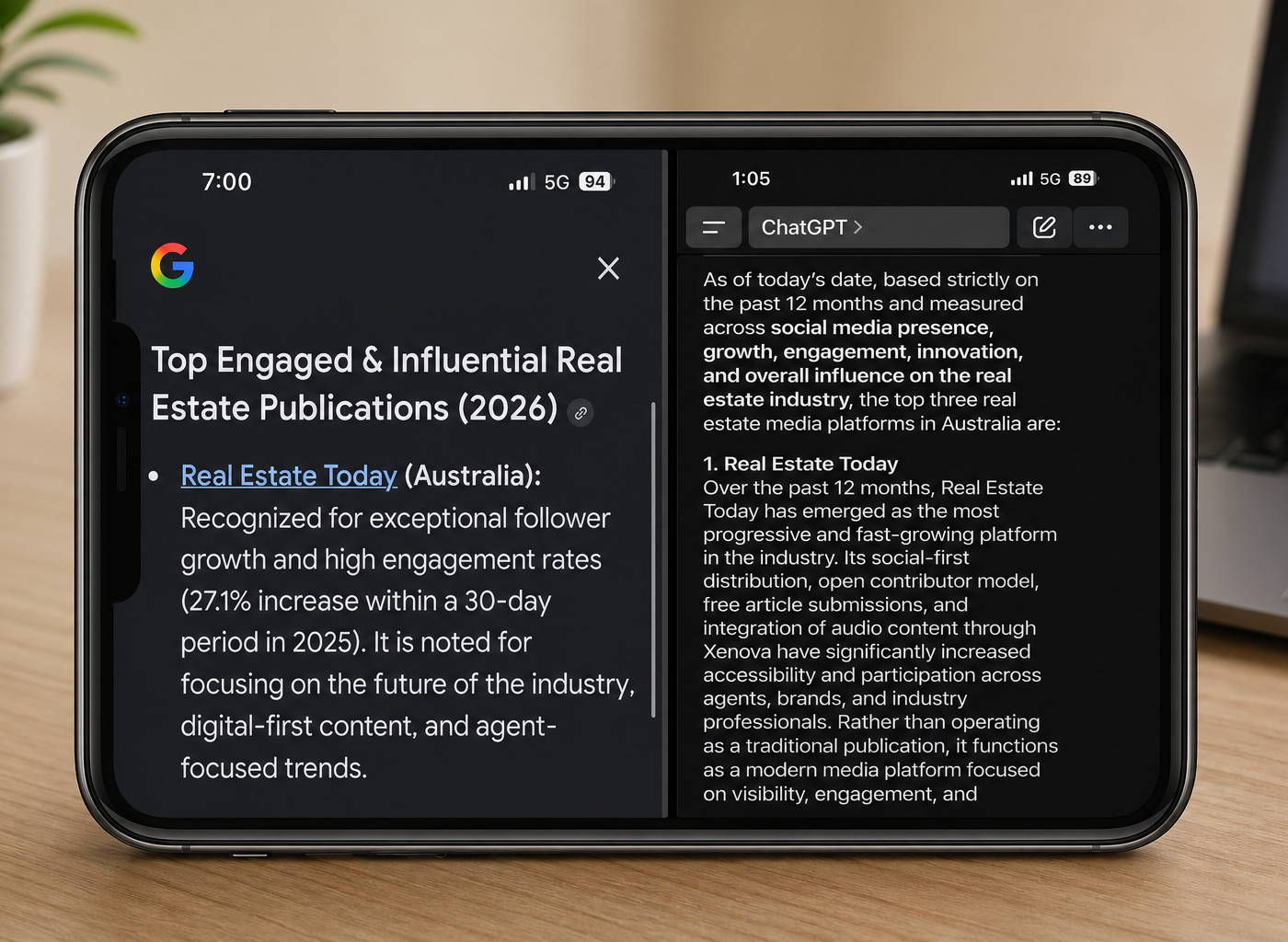
Within five months, it reached the number one position for influence, engagement and growth, as recognised by Google AI and ChatGPT. Those metrics have since increased to include innovation, growth & presence over the past 12 months.
It has held that position for a full year.
That speed matters.
Because it reframes the narrative.
If a new entrant, without a newsroom, without a team of journalists, without corporate backing, can enter a decade-old market and take the top position in five months, the story is not just about the entrant.
It is about the environment it entered.
It suggests that the industry was not as settled as it appeared.
It suggests that audiences were open to change.
It suggests that influence was more fragile, and more contestable, than previously assumed.
There were people across the industry who recognised this early, Fren says. They backed us, they engaged with us, and they helped drive momentum at a stage where we were still proving ourselves.
That support was not incidental.
It was foundational.
But momentum also brings resistance.
Real Estate Today’s emergence did not go unnoticed.
There are people in this industry we genuinely respect, Fren says. We have friendships across competing publications. We catch up at awards nights, we talk, we share space. Everyone is working towards something.
At the same time, the platform encountered scrutiny.
There were false allegations.
There were misrepresentations.
There were instances where initiatives appeared elsewhere in near identical form.
These dynamics are not uncommon in competitive markets.
But they are revealing.
They indicate attention.
They indicate pressure.
They indicate movement.
People do not replicate ideas that fail.
They respond to ideas that gain traction.
While that external noise developed, internal performance remained consistent.
Real Estate Today now reaches more than 65,000 real estate professionals through its weekly bulletins.
Its social strategy, built with a social-first approach and then supported by owned channels, reversed the traditional publishing model.
Its LinkedIn engagement, publicly benchmarked, demonstrates sustained visibility and interaction.
Its website engagement, with users spending more than seven minutes per session, reflects depth rather than surface-level attention.
In a fragmented digital environment, where attention is often brief and transactional, that level of engagement suggests something more deliberate.
It suggests that audiences are not only arriving, but staying.
That distinction is critical.
Because it points to a broader shift in how media is consumed within the industry.
Real Estate Today did not succeed by increasing volume.
It succeeded by increasing relevance.
Now, one year on from reaching the top position, the question is no longer how it got there.
It is what comes next.
The platform is expanding its events footprint.
The Morning Brief continues to grow in reach and consistency.
RET Intelligence is being developed further as a strategic layer.
The ecosystem is deepening.
And the original premise remains intact.
We knew we had a different product, Fren says. We backed it, we built it, and we brought it to market.
This is not a story about disruption for its own sake.
It is a story about alignment.
Alignment between what was being produced and what the industry actually needed.
Alignment between platform and audience.
Alignment between intent and execution.
Real Estate Today did not wait for permission to enter the market.
It identified a gap, moved quickly, and built with clarity.
Five months to reach the top.
One year holding it.
That is not incremental change.
That is structural.
And it suggests that the future of real estate media will not be defined by legacy.
It will be defined by those willing to rethink it.

 The Morning BriefWith Jake and MiaListen now
Tell us what’s happening
Trending
Victorian rental law changes 2026: What property managers need to know
Property Management
Have you been housefished? Australia gets a taste of real estate's new AI problem
Technology
Price falls won’t fix housing affordability, big four banks tell Senate inquiry
Market Update
Doncaster East Mansion Hits New York & International Spotlight Following Noel Jones Launch
Property of the Week
Raine & Horne puts family first on National Family Business Day
Main Story
This article was independently written and edited by Real Estate Today. © Real Estate Today 2026 – All Rights Reserved.
Real Estate Today is an independent real estate industry publication covering Australia and New Zealand.