
Victoria’s rental reforms are rolling out in stages, with major changes already in force and another important set of obligations beginning on 13 October 2026. For property managers and agency leaders, the issue is no longer simply knowing that the law has changed. It is making sure office processes, applications, advertising, compliance records, safety checks and bond procedures have changed with it.
Victoria has introduced a substantial series of rental reforms affecting the way properties are advertised, tenants are selected, rents are increased, bonds are managed and rental properties are maintained.
Some changes took effect in November 2025. More commenced on 31 March and 1 July 2026. Another significant group begins on 13 October 2026, followed by new minimum energy-efficiency standards from 2027.
For property managers, principals and rental providers, this is what matters now.
No-fault evictions have been banned
Since 25 November 2025, Victorian rental providers can no longer issue a notice to vacate without a valid reason simply because a fixed-term rental agreement has ended.
When a fixed-term agreement finishes, it generally becomes a periodic agreement unless the parties enter another fixed-term agreement or a valid ground exists for ending the tenancy.
Existing valid reasons, including certain sales, renovations and breaches of the rental agreement, remain available under the legislation.
For agencies, this means end-of-lease workflows should not automatically assume the renter can simply be asked to leave when the fixed term expires.
Property managers now need to allow 90 days for rent increases
The minimum notice period for a rental increase changed from 60 days to 90 days on 25 November 2025.
The 90-day period also applies to certain notices to vacate, although shorter periods may still apply in circumstances involving renter fault.
For property management departments, this is a relatively simple change operationally, but one that can cause problems if old templates, automated workflows or diary systems are still using the former 60-day period.
RET checklist
Property management teams should check:
automated rent-review reminders
notice templates
CRM workflows
landlord communication templates
staff procedure manuals
outsourced administration processes
If any still refer to 60 days, they should be reviewed.
Rental bidding rules are tougher
Victoria has also strengthened its restrictions on rental bidding.
Agents and rental providers cannot accept an offer from a renter to pay more than the advertised rental amount or more than one month's rent in advance.
The changes build on earlier rules preventing agents and rental providers from soliciting or encouraging offers above the advertised rent.
For agencies operating in highly competitive rental markets, this means applicant conversations and staff training are particularly important.
A prospective renter offering more money does not automatically mean an agency is permitted to accept it.
Minimum standards now matter before the property is advertised
One of the most operationally important changes for property managers is the timing of Victoria's rental minimum standards.
Since 25 November 2025, rental providers and agents must reasonably ensure a property complies with the minimum standards when it is advertised or offered for rent, not simply before the renter moves in.
Victoria's minimum standards cover areas including bathrooms, electrical safety, heating, locks, lighting, mould and damp, structural soundness, toilets, ventilation, windows and window coverings.
From 1 December 2025, internal blind and curtain cords must also be secured so they cannot form dangerous loops.
What this means inside an agency
The compliance check effectively needs to move further forward in the leasing process.
An agency should not be discovering significant minimum-standard problems after photography, advertising and open homes have already begun.
For many property management departments, the safer workflow is:
Compliance check → property ready → advertising → applications → tenancy
rather than:
Advertising → applications → compliance check
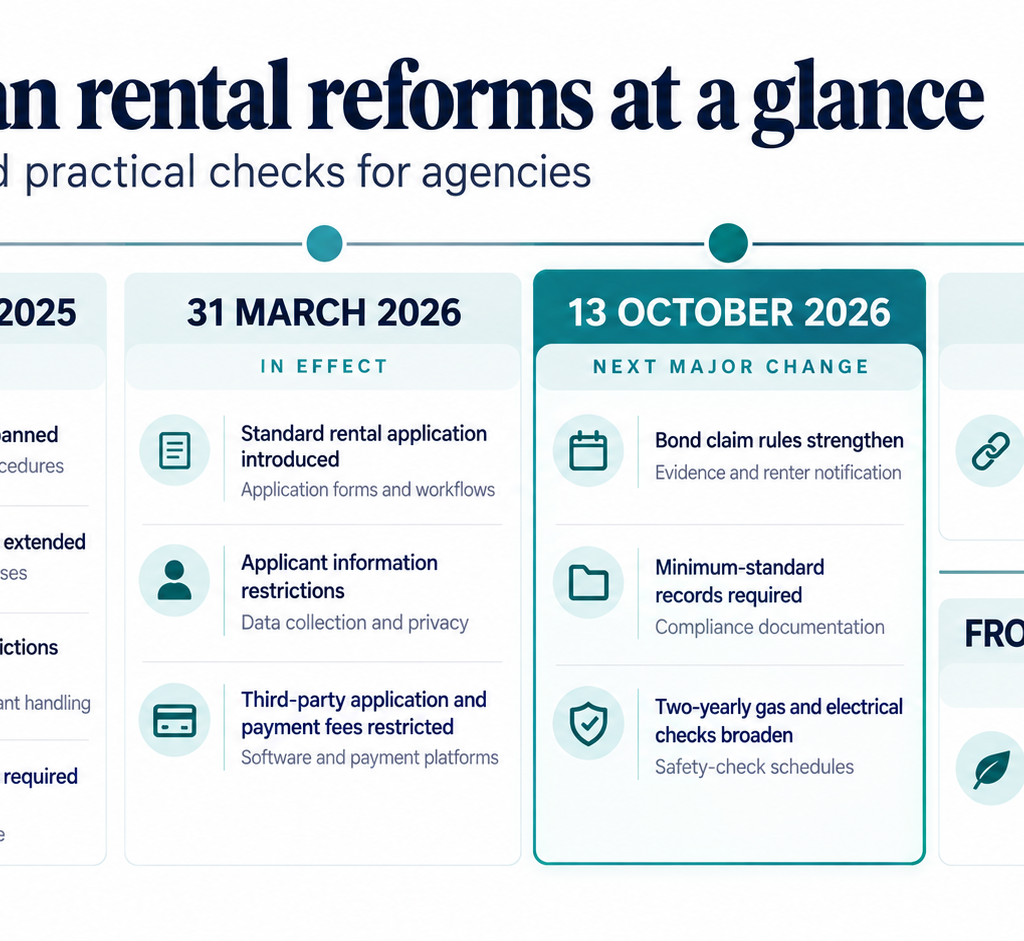
Rental applications changed on 31 March 2026
Since 31 March 2026, Victorian rental providers and their agents must use the prescribed rental application process.
Agents are also limited in the information they can request from prospective renters. Information sought should be relevant to assessing the applicant's suitability, identity and ability to pay the advertised rent.
This is particularly relevant for agencies using external application software.
Property managers should know not only what their own team asks applicants for, but also what their technology provider is collecting.
Application and rent-payment platform fees have also changed
From 31 March, third-party businesses operating rental application or rent-payment platforms were prohibited from charging renters certain application and payment fees.
Agents may continue using third-party platforms, but the rules governing what renters can be charged have tightened.
A further change begins on 13 October 2026, when rental providers and agents themselves will also be prohibited from charging renters fees to make a rental application.
Agencies using proptech platforms should confirm how their provider handles these requirements rather than assuming the software is automatically compliant.
Portable rental bonds are now operating
Victoria's Portable Rental Bond Scheme commenced on 1 July 2026.
Eligible renters can transfer an existing bond to a new rental property rather than having to fund an entirely new bond while waiting for the old bond to be returned.
The scheme operates through the Residential Tenancies Bond Authority and is optional for renters. The transfer currently carries a $25 application fee.
For property managers, the practical issue is knowing how to recognise and process a portable bond application when an incoming renter chooses that option.
The scheme does not remove the ability of a former rental provider to make a legitimate claim against the previous bond. Processes are in place for dealing with claims made after a bond has been transferred.
The next major date is 13 October 2026
This is the date Victorian property management departments should now have marked in their calendars.
Several additional requirements begin on 13 October 2026.
Bond claims will require stronger evidence
Rental providers will need to notify renters in advance when making a bond claim at the end of a rental agreement and provide evidence supporting that claim.
For property managers, documentation becomes even more important.
Condition reports, inspection photographs, invoices, repair records, correspondence and other evidence may become critical when substantiating a bond claim.
Agencies will need evidence of minimum-standard compliance
Rental providers will also be required to retain sufficient records showing that a property complied with Victoria's rental minimum standards when it was advertised or offered for rent.
This changes compliance from simply:
“Was the property compliant?”
to:
“Can we prove the property was compliant at the relevant time?”
That distinction matters.
Agencies should consider how evidence is stored against each property, how long it is retained, who is responsible for uploading it and whether it remains accessible when staff members change.
Gas and electrical safety requirements broaden
From 13 October, rental providers and their agents must arrange gas and electrical safety checks every two years across rental agreements, including agreements that began before that date.
The work must be completed by appropriately qualified tradespeople.
This could require agencies managing large portfolios to review hundreds or thousands of property records.
Waiting until October to identify overdue properties may create an unnecessary compliance backlog.
What should Victorian property managers be doing now?
The reforms are substantial, but the operational response does not need to be complicated.
1. Audit your portfolio
Identify which properties require:
gas safety checks
electrical safety checks
smoke alarm checks
minimum-standard work
compliance documentation
upcoming energy-efficiency upgrades
2. Review your leasing workflow
Confirm minimum standards before a property is advertised.
Do not rely on discovering compliance problems immediately before occupation.
3. Review application software
Check:
which application form is being used
what information applicants are being asked for
what information third-party systems collect
whether any applicant fees are being charged
how applicant information is stored and destroyed
4. Review your bond-claim process before October
Ask whether your agency can consistently produce evidence supporting bond claims.
If documentation is scattered across emails, phones and individual staff accounts, now is a good time to tighten the process.
5. Check rent-review automation
Make sure your property management platform and office procedures reflect the 90-day rent-increase notice period.
6. Start preparing for 2027
Victoria's next wave of minimum energy-efficiency requirements begins to phase in from 1 March 2027.
They cover areas including heating, cooling, hot water, showerheads, ceiling insulation and draughtproofing, with requirements applying at different stages and under different triggers.
For larger portfolios, identifying affected properties early could be considerably easier than trying to manage upgrades once deadlines begin arriving.
The bigger change for property management
The most important theme running through Victoria's rental reforms is not any single rule.
It is the increasing expectation that property management businesses can demonstrate compliance, not simply say they have complied.
Advertising, applications, safety checks, rent reviews, property standards, renter data and bond claims are increasingly connected to records and evidence.
For property management leaders, that makes systems and processes almost as important as knowing the legislation itself.
An office may understand the new rules perfectly but still expose itself to problems if outdated templates, old software settings or inconsistent record keeping remain in place.
Key dates Victorian agencies should keep
25 November 2025: no-fault eviction ban, 90-day rent-increase notice period, stronger rental-bidding rules and minimum standards before advertising.
1 December 2025: blind and curtain cord safety requirements.
31 March 2026: prescribed rental application requirements, applicant-information restrictions and changes affecting application and rent-payment fees.
1 July 2026: Portable Rental Bond Scheme commenced.
13 October 2026: strengthened bond-claim requirements, minimum-standard compliance records and broader two-yearly gas and electrical safety-check obligations.
From 1 March 2027: new energy-efficiency minimum standards begin phasing in.
Keep this page bookmarked
Victoria's rental reforms are being implemented progressively.
Real Estate Today will continue updating this guide as further requirements commence and new regulatory guidance becomes available.
Last updated: 18 September 2026
This article provides general industry information and is not legal advice. Property managers, rental providers and agencies should refer to Consumer Affairs Victoria and the legislation applying to their individual circumstances.

 The Morning BriefWith Jake and MiaListen now
Tell us what’s happening
Trending
Have you been housefished? Australia gets a taste of real estate's new AI problem
Technology
Price falls won’t fix housing affordability, big four banks tell Senate inquiry
Market Update
Doncaster East Mansion Hits New York & International Spotlight Following Noel Jones Launch
Property of the Week
Raine & Horne puts family first on National Family Business Day
Main Story
Perth and Melbourne Commercial Leaders Join Forces to Launch NAI Harcourts RPG
Network News
This article was independently written and edited by Real Estate Today. © Real Estate Today 2026 – All Rights Reserved.
Real Estate Today is an independent real estate industry publication covering Australia and New Zealand.