
Industry News
NSW Fair Trading warns agents as third-party deposit review continues
NSW Fair Trading is assessing third-party property deposit arrangements, reminding agents of their ongoing compliance responsibilities.
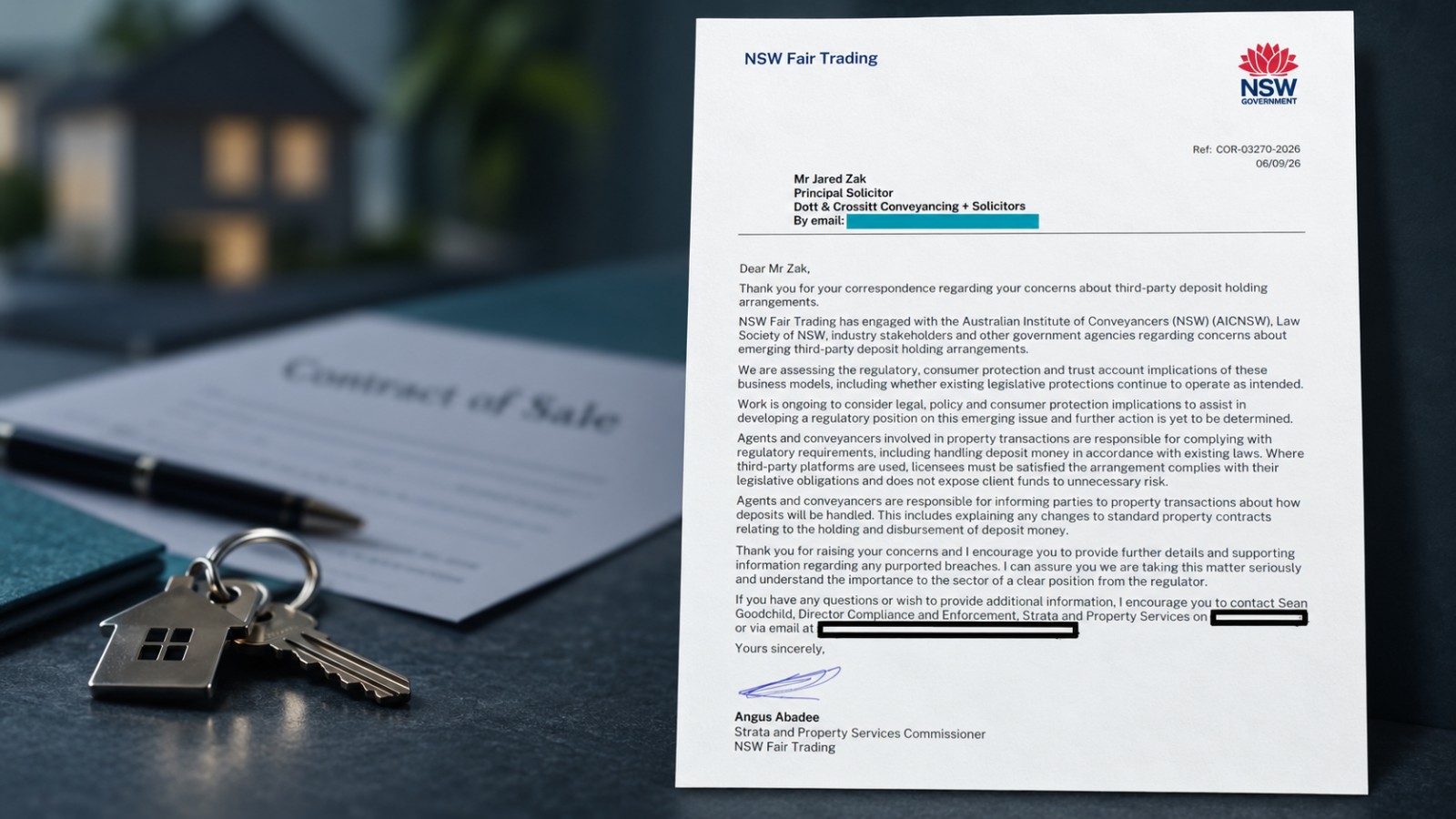
NSW Fair Trading has confirmed it is developing a regulatory position on emerging third-party property deposit arrangements, while reminding agents and conveyancers that responsibility for compliance remains with them when outside platforms are used.
In correspondence dated 6 September and addressed to Dott & Crossitt principal solicitor Jared Zak, Strata and Property Services Commissioner Angus Abadee said the regulator was assessing the legal, consumer protection and trust-account implications of the emerging business models.
The letter confirms NSW Fair Trading has engaged with the Australian Institute of Conveyancers NSW, the Law Society of NSW, industry stakeholders and other government agencies.
A central question under examination is whether existing legislative protections continue to operate as intended when a purchaser’s deposit is directed to a third-party provider rather than the trust account traditionally nominated in a property transaction.
“Work is ongoing to consider legal, policy and consumer protection implications,” the Commissioner wrote, adding that further action had not yet been determined.
Responsibility remains with licensees
While the letter does not declare third-party deposit arrangements unlawful, it delivers a clear compliance message to the property industry.
NSW Fair Trading said agents and conveyancers involved in property transactions remain responsible for meeting their regulatory obligations, including handling deposit money in accordance with existing laws.
Where a third-party platform is involved, licensees must satisfy themselves that the arrangement complies with their legislative obligations and does not expose client funds to unnecessary risk.
The regulator also said agents and conveyancers are responsible for telling buyers and vendors how the deposit will be handled. That includes explaining any departure from the deposit-holding and disbursement provisions ordinarily contained in standard property contracts.
For agents, the practical message is significant. Outsourcing the physical handling of a deposit should not be interpreted as outsourcing the legal responsibility attached to the transaction.
Court proceedings did not resolve the underlying question
The regulatory update follows a high-profile dispute between Agency Settlements, a Riverstone Partners business, and Mr Zak over comments he made about third-party deposit-holding practices.
Agency Settlements uses a contractual arrangement under which it is nominated as the deposit holder and stakeholder, with the vendor and purchaser agreeing to the arrangement through a special condition.
The company commenced proceedings against Mr Zak after he raised concerns about what critics have described as “deposit flicking”, where property deposits are directed away from an agent’s conventional trust account to another provider.


In August, the NSW Supreme Court rejected Agency Settlements’ application for an interim injunction that would have restrained Mr Zak from making certain statements about its model.
Importantly, that decision did not produce a final ruling that the Agency Settlements model was lawful or unlawful.
Justice James Hmelnitsky found Agency Settlements had a good arguable case concerning the operation of section 86 of the Property and Stock Agents Act 2002. However, the Court determined that the balance of convenience did not support restraining Mr Zak while the substantive dispute remained unresolved.
Agency Settlements subsequently discontinued the broader proceedings and was ordered to pay Mr Zak $60,000 in costs.
Agency Settlements has maintained that its contractual model is lawful, that buyers and vendors consent to its appointment, and that the system provides an alternative way of managing property deposits. Mr Zak and other critics have continued to argue that the arrangements may create legal and consumer-protection risks.
Industry still waiting for a definitive position
The conclusion of the court proceedings did not settle the broader regulatory question.
NSW Fair Trading’s latest correspondence confirms the matter remains under active consideration and that the regulator is examining the operation of the sector as a whole, rather than announcing a finding against any individual provider.
That distinction matters.
Third-party deposit models have not been prohibited, but nor has NSW Fair Trading given the industry a general regulatory clearance to use them.
Until a definitive position is released, agencies considering such an arrangement will need to examine the contractual authority, consumer disclosures, trust-account protections and allocation of responsibility behind the model.
The emerging message from the regulator is that convenience does not displace accountability. If an agent participates in a third-party deposit arrangement, the obligation to ensure the transaction is lawful and the client’s money is properly protected remains firmly in place.
Real Estate Today in your inbox
The RET Nightcap and The Weekly Wrap, free for everyone in the industry.
Buyer enquiry this week, compared with last week?
Anonymous, one tap, no names. See straight away what’s happening in your local market.
Latest from The Chat podcast
Inside H360: how Harcourts turns data into better businessesNick Jewitt, Head of Data and Analytics, Harcourts · 21 Oct 2026
Latest stories