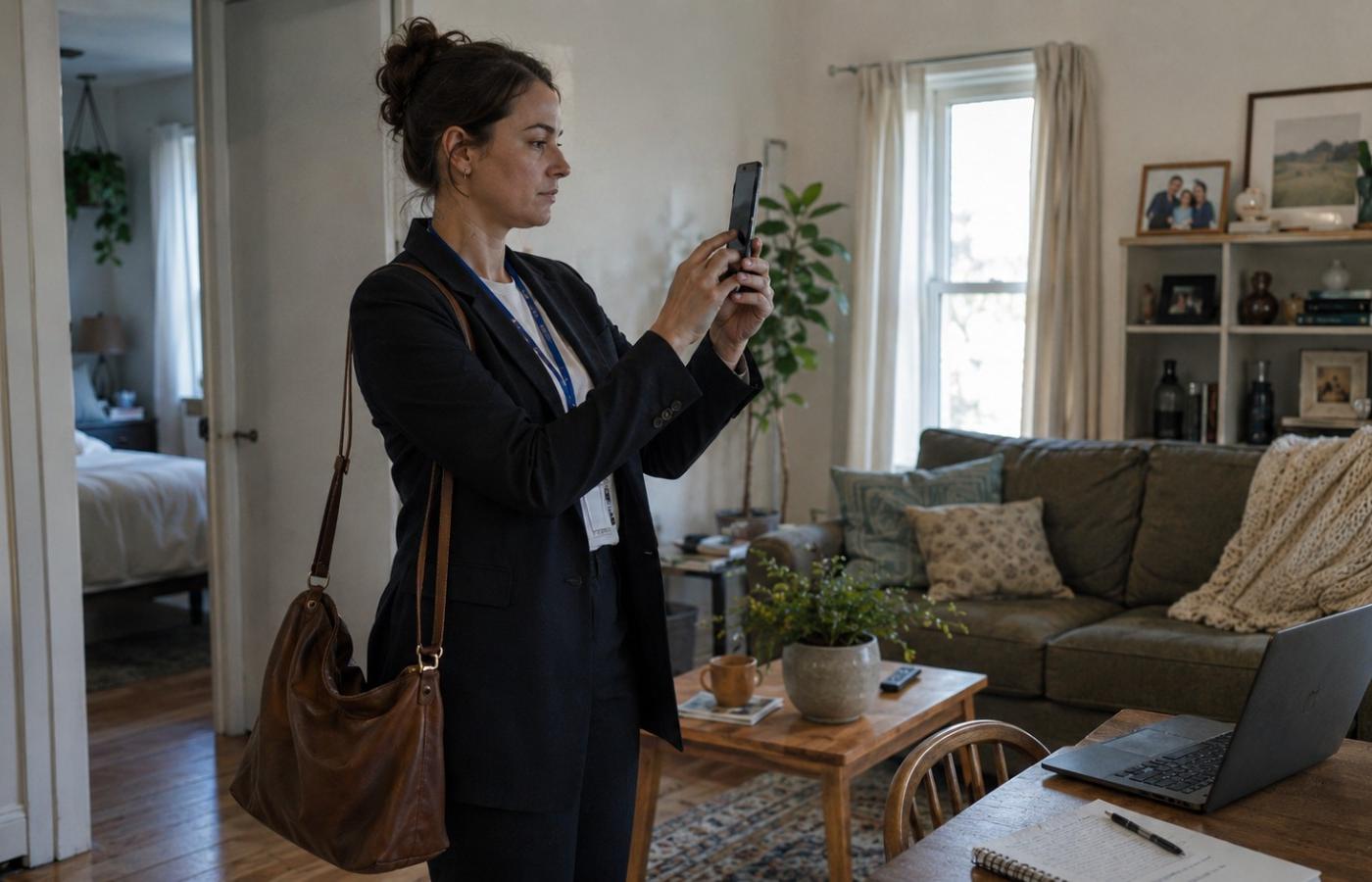
A Victorian push to restrict video recording during routine rental inspections has raised a bigger question for real estate agencies. When a property manager records inside an occupied home, what happens to that footage once the inspection is over?
Routine inspections have changed.
What was once a property manager walking through a rental with a clipboard and camera can now involve smartphones, inspection apps, cloud platforms and 360 degree technology capable of creating a detailed digital record of almost every room in a property.
For property managers, that technology can make inspections faster, reporting more comprehensive and communication with rental providers significantly easier.
But it also creates a question agency principals may need to start taking much more seriously.
What exactly are we recording, and what happens to it afterwards?
That question has moved into the spotlight in Victoria, where a petition currently before Parliament is calling for continuous video recording during routine rental inspections to be prohibited.
Petition #202627, sponsored by Greens MP Gabrielle de Vietri and open until 31 August, asks the Victorian Government to amend the Residential Tenancies Act to prohibit continuous video sweeps of occupied rental properties during routine inspections.
It also calls for digital documentation to be restricted to specific structural defects or maintenance issues, rather than recording undamaged personal spaces, furniture and living areas simply to assess housekeeping. (Parliament of Victoria)
Whether the Victorian Government ultimately accepts that argument is one question.
For the real estate industry, however, there is another.
Are agency policies keeping pace with the technology property managers are now carrying through the front door?
The inspection itself isn't the issue
Routine inspections are a fundamental part of property management.
In Victoria, a rental provider or their agent can conduct a general inspection after the first three months of a rental agreement and no more frequently than every six months. At least seven days' notice is generally required. (Consumer Affairs Victoria)
Property managers need to understand the condition of the properties they manage.
Rental providers expect evidence.
Maintenance needs to be identified.
Damage needs to be documented.
And if a dispute develops later, having an accurate record of what existed at a particular point in time can be extremely valuable.
The industry therefore has legitimate reasons for photographing and documenting properties.
The more difficult question is where documentation ends and unnecessary collection begins.
There is a substantial difference between photographing water damage in a ceiling and creating several minutes of continuous video showing everything inside an occupied home.
Bedrooms.
Family photographs.
Children's belongings.
Computer screens.
Medication.
Documents sitting on desks.
Expensive possessions.
Potentially even the occupants themselves.
A property manager may be interested only in the condition of the walls, floors and fixtures.
The camera does not make that distinction.
Where does all the footage go?
This is where the conversation becomes particularly relevant to agency principals.
If your property management team conducts 200 routine inspections this month and captures video during each one, your business could potentially be creating hundreds of new digital records from inside occupied homes.
Where are those records stored?
Are they automatically uploaded into inspection software?
Are copies retained on employees' phones?
Do they sit in cloud storage?
Can rental providers download them?
Can former employees still access them?
Does a third party technology provider retain a copy?
How long are they kept?
And who within the business actually knows the answers?
These are not questions that can simply be left to whichever inspection platform an agency happens to use.
Victorian rental providers and agents already have legal responsibilities around renter information, including taking reasonable steps to protect information from misuse, loss and unauthorised access, modification or disclosure. There are also requirements concerning destruction or de-identification in certain circumstances. (Consumer Affairs Victoria)
Separately, where the federal Privacy Act applies, the Office of the Australian Information Commissioner says photographs and videos can constitute personal information where somebody's identity is clear or could reasonably be determined. Organisations covered by the Privacy Act generally may only collect personal information that is reasonably necessary for their functions or activities. (OAIC)
That does not automatically mean routine inspection footage is unlawful.
It does mean agencies should understand what they are collecting, why they are collecting it and how it is being handled.
Property technology is already attracting attention
There is another reason principals should pay attention.
Regulators are already looking closely at how technology businesses operating in Australia's rental market collect personal information.
In April, the Australian Privacy Commissioner found that rental technology platform 2Apply, operated by InspectRealEstate, had collected excessive personal information from prospective renters and had done so by unfair means.
The determination concerned rental applications, not routine inspection footage, and the two issues should not be confused.
But the broader message for the property industry is difficult to ignore.
Just because technology allows a business to collect more information does not necessarily mean that information needs to be collected. (OAIC)
That principle becomes increasingly relevant as artificial intelligence, automated reporting, video inspection platforms and cloud based property management systems become embedded in everyday agency operations.
The technology is moving quickly.
Internal policies may not be.
This could become a principal problem, not a PM problem
It would be easy to treat the Victorian petition as another argument between tenants and property managers.
That misses the more important industry issue.
The property manager holding the phone may be the person capturing the footage, but responsibility for agency procedures ultimately sits higher.
Principals and heads of property management should know what their teams are recording.
They should know which platforms are receiving it.
They should understand who has access to it.
And there should be a clear business reason for why that information is being collected in the first place.
That may require agencies to look again at their routine inspection procedures.
Do property managers need to record an entire bedroom, or would a photograph of the damaged carpet achieve the same purpose?
Does a rental provider need access to continuous footage of an occupied home, or only evidence relevant to the condition of their asset?
Are staff being trained on what should not be captured?
Does the agency have a retention policy covering inspection photos and video?
And if a renter asked tomorrow for an explanation of exactly what had been recorded inside their home and where it was stored, could the agency answer confidently?
Those questions are worth asking even if Victoria never changes the legislation.
The next property management risk may already be sitting in the cloud
Real estate has embraced technology because property management desperately needed efficiency.
That should continue.
Better inspection systems, automation and digital reporting can remove hours of administration from already stretched property management teams.
The answer is not to push property managers backwards.
But efficiency cannot be the only consideration.
Every new piece of data an agency creates also has to be stored, protected, managed and eventually dealt with.
The Victorian petition may or may not result in new restrictions.
What it has done is expose an issue the industry should probably confront before regulation forces it to.
The question is no longer simply whether a property manager can walk through a rental property recording everything they see.
For agency principals, the better question may be much simpler.
Do we actually need to?

 The Morning BriefWith Jake and MiaListen now
Tell us what’s happening
Trending
The Truth Hurts, But Read This Anyway
Network News
Harcourts Solutions Golf Day raises $13,000 for Mitchelton Special School
Community
What Actually Makes a Healthy Real Estate Office? The Numbers Beyond GCI
Opinion
NSW domestic abuse rental reforms shift key compliance duties onto agents
Property Management
The Living Company announces ~A$1bn investment in Melbourne CBD
Commercial
This article was independently written and edited by Real Estate Today. © Real Estate Today 2026 – All Rights Reserved.
Real Estate Today is an independent real estate industry publication covering Australia and New Zealand.