


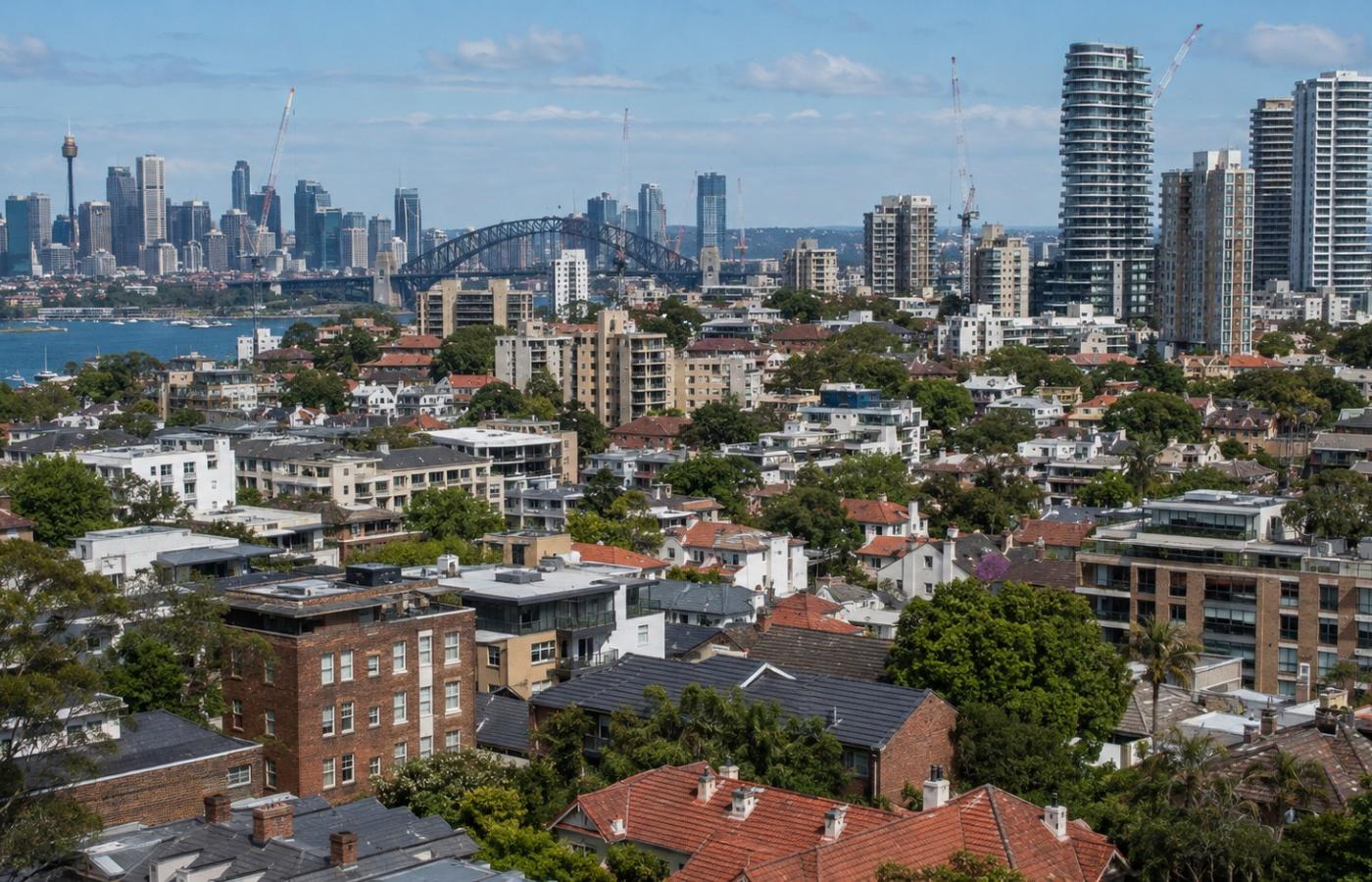
A battle over thousands of new homes around Woollahra and Edgecliff is becoming far more than a planning dispute. For agents, developers, project marketers and property managers, the outcome could reshape one of Sydney's most tightly held property markets for decades.
Sydney's eastern suburbs are heading towards a property transformation.
The only question is how big it will be.
Almost a year after the NSW Government announced plans to rezone land around Edgecliff and a proposed new Woollahra railway station to enable up to 10,000 new homes, Woollahra Council has put forward a dramatically different vision.
Its alternative would provide capacity for approximately 2,200 to 3,600 additional dwellings over 15 to 20 years, significantly below the state government's ambition.
The numbers have already created a political fight.
For the real estate industry, however, the more important question is what either scenario could mean for property.
Because whether the final number is closer to 3,600 or 10,000, one of Sydney's most established and supply constrained markets is facing considerably more housing.
That means new development sites.
More apartments.
More project marketing.
More rental stock.
Changes to local buyer profiles.
Potential changes to land values.
And an entirely different conversation for agents operating in Woollahra, Edgecliff and surrounding eastern suburbs.
The NSW Government's proposal covers land around the existing Edgecliff station and proposed Woollahra station, with planning investigations extending roughly 400 metres around Edgecliff and 800 metres around the new Woollahra station.
Woollahra Council says the area under investigation represents approximately 18.85 per cent of its local government area, with around half of the proposed precinct sitting within heritage conservation areas.
That immediately explains why the argument has become so intense.
This is not a greenfield growth corridor.
It is Woollahra.
Land is scarce, property values are high, heritage controls are extensive and much of the surrounding housing stock has existed for generations.
Adding thousands of homes here is therefore unlikely to simply create more supply.
It could alter the economics of the entire local property market.
The difference between 3,600 and 10,000 is enormous
Council's alternative planning work reportedly contemplates buildings predominantly between four and 12 storeys, with greater height concentrated in specific locations.
The proposal includes potential towers reaching around 35 storeys set back from Edgecliff station, buildings up to 20 storeys around Fullerton Street and heights of up to 12 storeys near the proposed Woollahra station.
That is hardly a low density outcome.
But it is substantially different from trying to create capacity for up to 10,000 homes.
The NSW Government's position is that significantly more housing needs to be accommodated close to existing infrastructure, jobs and public transport.
When the Woollahra station proposal was announced in August 2025, the Government argued that the municipality had experienced an 11 per cent population decline over the previous 50 years while Greater Sydney's population had risen by 74 per cent.
It also pointed to available capacity on the Eastern Suburbs rail line and argued that housing growth needed to be distributed more evenly across Sydney.
Council has consistently argued for a different approach, raising concerns about heritage, infrastructure, local character, tree canopy and the scale of development contemplated under the state proposal.
Those arguments will continue.
But agents should probably start looking beyond the political contest.
Because development is already moving.
Edgecliff is already beginning to change
The future of this market is not purely theoretical.
In July, the Department of Planning, Housing and Infrastructure finalised a planning proposal for 8 to 10 New McLean Street in Edgecliff allowing controls equivalent to an approximately 18 storey development, after Woollahra Council had opposed the proposal.
Another planning proposal at 203 to 233 New South Head Road has progressed with planning controls contemplating a maximum building height of 128 metres, effectively around 37 storeys, subject to the planning process and other requirements.
A separate approved development at Edgecliff includes a 17 storey shop top housing project with residential, retail and commercial components and affordable housing.
Individually, these developments can be viewed as projects.
Collectively, they point towards something bigger.
Edgecliff is moving towards considerably greater density.
For agents working in the area, that changes the conversation with property owners.
A property that has traditionally been valued purely as a house, block of apartments or commercial building may increasingly attract another layer of interest.
Development potential.
And when planning controls change, the highest value buyer for a property can change with them.
Development sites could become the new battleground
This is where the proposed rezoning becomes particularly important for sales agents and commercial operators.
Increasing allowable height or floor space can alter the underlying value of land.
Sites capable of amalgamation can become more valuable together than separately.
Older apartment buildings may attract developer interest.
Commercial properties may suddenly have significantly different redevelopment potential.
And homeowners who previously had little reason to speak with a development specialist may find themselves receiving approaches from buyers seeking strategic sites.
Council's own Edgecliff planning work acknowledges the need to manage site amalgamation, increased building heights, floor space, affordable housing contributions and community infrastructure as density increases.
For agents, understanding the planning map could therefore become as important as understanding comparable sales.
The person who knows which sites have genuine redevelopment potential, which require amalgamation and which are constrained by heritage, access or infrastructure may have a significant advantage in winning future business.
There is also a prospecting opportunity.
If zoning changes the potential use of a property, the owner needs to know.
That creates conversations.
And in real estate, conversations eventually create transactions.
Project marketers could be looking at a completely new pipeline
Sydney's eastern suburbs have never lacked demand.
What they have often lacked is large scale new housing supply.
If thousands of additional apartments are ultimately delivered around Edgecliff and Woollahra, project marketers could be looking at a pipeline unlike anything the immediate market has experienced for years.
But the product will matter.
This is unlikely to be a conventional high volume outer suburban apartment market.
Location, land costs and existing property values could push developers towards premium apartments, downsizer product and larger residences.
That raises another important question.
Who will actually buy the new homes?
Existing eastern suburbs homeowners wanting to downsize without leaving their community are an obvious market.
So are professionals seeking proximity to the CBD.
Investors may return if rental fundamentals support the numbers.
International and interstate buyers could also form part of demand for premium projects.
But 10,000 homes requires a very different depth of demand from 3,600.
That makes the final planning outcome commercially significant.
For developers and project marketers, the difference is not just thousands of apartments.
It is competition.
More projects mean more developers competing for buyers at the same time.
That can influence apartment design, incentives, marketing budgets, pricing and release strategies.
Property management could be one of the quiet winners
Then there is property management.
Thousands of additional apartments potentially means thousands of additional rental properties.
Not every new dwelling will become an investment, but even a fraction of the proposed supply entering the rental market would create a meaningful new management pool.
For agencies with established property management businesses in the eastern suburbs, that represents potential long term recurring revenue.
The opportunity begins well before buildings are completed.
Project marketers, developers and property managers can establish relationships with investors at the point of purchase rather than waiting until settlement.
Agencies capable of connecting sales, project marketing and property management could potentially retain clients across the entire property cycle.
A purchaser buys off the plan.
The agency manages the property after settlement.
Years later, the same agency sells it.
That is where increased housing supply can become more than a transaction opportunity.
It becomes a database opportunity.
More apartments could also change the established market
There is another side to the equation.
What happens to existing property when substantially more stock enters the market?
The answer will not be uniform.
Scarce freestanding homes may become even more differentiated if surrounding density increases.
Older apartments may face greater competition from newer buildings with modern amenities.
Some ageing strata buildings may become redevelopment targets.
Other buildings may find their land component increasingly valuable.
Investors could have more choice.
Renters could have more choice.
Downsizers who previously stayed in large family homes because suitable local apartments were unavailable may finally have somewhere to move.
That can unlock stock elsewhere in the market.
A new three bedroom apartment in Woollahra does not just create one new dwelling.
If the buyer sells a five bedroom house nearby to move into it, another property enters the market.
Housing supply can create chains of transactions.
For agents, those secondary movements may be just as commercially important as the new developments themselves.
The argument is not over
There is one critical point for the industry.
Nothing has suddenly changed from 10,000 approved homes to 3,600.
The NSW Government remains responsible for the state led rezoning and says the Edgecliff Woollahra precinct proposal is expected to go on public exhibition in late 2026.
Woollahra Council is a stakeholder in that process, not the final decision maker.
Council's alternative therefore adds another scenario to the debate rather than replacing the state's proposal.
What eventually emerges could look different again.
That uncertainty makes predicting individual property outcomes difficult.
But the direction is becoming much easier to see.
More housing is coming.
The planning controls around Edgecliff and Woollahra are changing.
Development pressure is increasing.
And some of the most tightly held land in Sydney is being reconsidered through an entirely different planning lens.
For the real estate industry, waiting until the final towers appear would be missing the point.
The opportunity starts much earlier.
It starts when landowners begin asking what their property could now be worth.
When developers start assembling sites.
When downsizers start considering new apartments.
When investors start looking at future rental supply.
And when agents begin understanding which parts of their market could look completely different in ten years.
The political argument may be about whether Woollahra should accommodate 3,600 homes or 10,000.
For real estate professionals, the more immediate question is simpler.
Are you ready for what happens when thousands of new homes arrive in a market that has historically had very few of them?
Because whichever number ultimately wins, Sydney's eastern suburbs are unlikely to look the same again.
This article was independently written and edited by Real Estate Today. Information was drawn from current NSW Government planning material, Woollahra Municipal Council planning information and reporting on Council's newly released alternative housing approach. The final Edgecliff Woollahra rezoning has not yet been determined.
© Real Estate Today Australia 2026. All Rights Reserved.
Programs

The Morning Brief
The essential real estate briefing to start the working day.
WITH JAKE & MIA · WEEKDAYS FROM 5:30AM

The 7:30 Report
The day's property news, context and what comes next.
WITH DAN & SARAH · FIVE NIGHTS A WEEK





Trending
Three heavyweights, one network: Eastern suburbs rivalry heats up
Industry News
The Truth Hurts, But Read This Anyway
Network News
Harcourts Solutions Golf Day raises $13,000 for Mitchelton Special School
Community
What Actually Makes a Healthy Real Estate Office? The Numbers Beyond GCI
Opinion
NSW domestic abuse rental reforms shift key compliance duties onto agents
Property Management
This article was independently written and edited by Real Estate Today. © Real Estate Today 2026 – All Rights Reserved.
Real Estate Today is an independent real estate industry publication covering Australia and New Zealand.