Real estate agents have spent years being told to polish their image.
Professional photography. Expensive cars. Immaculate suits. Carefully staged videos. Awards, rankings and sales results presented as proof that the person on the billboard is more successful than everyone else.
Brisbane agent David Pearce has taken a different approach.
He made himself the joke.
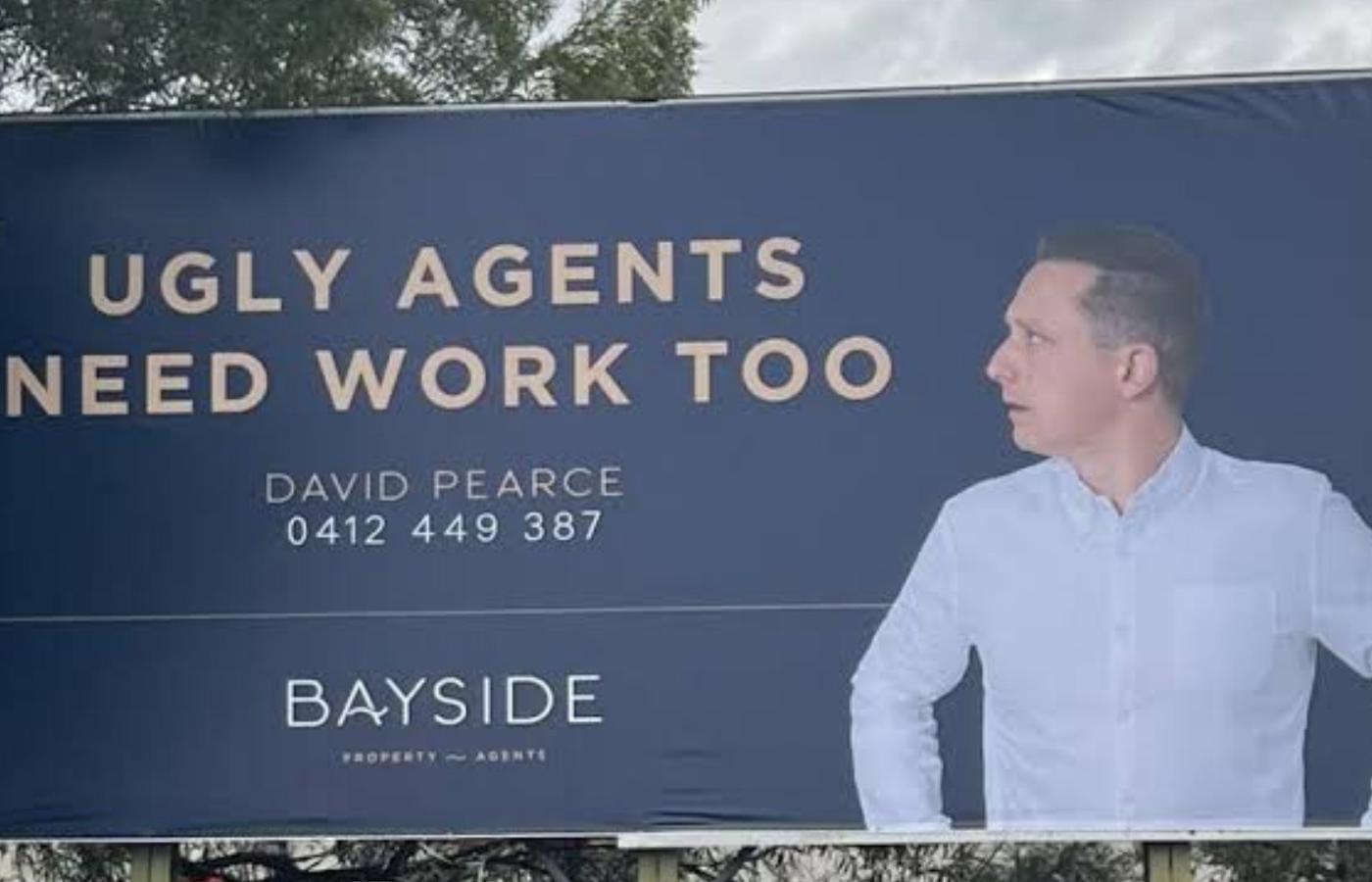
The co-founder of Bayside Property Agents has attracted widespread attention with a deliberately self-deprecating billboard campaign that plays with the public’s perception of real estate agents and Pearce’s willingness to laugh at himself.
The campaign began gaining significant online traction this week, reportedly prompting a surge of phone calls and leading to contact from at least one potential vendor.
Not every call was about selling property. Many people simply wanted to talk about the billboard.
That does not make the campaign unsuccessful.
It may be precisely why it worked.
Pearce operates in Brisbane’s Wynnum, Manly and Redlands markets and has previously used billboard lines including “Ugly agents need work too”. His latest campaign continues a marketing style built around humour, humility and making the agent appear more approachable.
According to Bayside Property Agents, Pearce and co-founder Luke Humphrys established the business with a focus on distinctive marketing, video and social media. Its stated philosophy is to “make your property famous”.
Pearce’s personal profile describes him as someone who takes his work seriously, but not himself.
That distinction is increasingly valuable.
Real estate marketing has become saturated with agents attempting to project authority, success and importance. The imagery is polished, the language is familiar and the message is usually some variation of the same claim.
Number one agent.
Record result.
Trusted local expert.
Award-winning service.
When everyone presents themselves in almost identical terms, perfection stops being distinctive.
It becomes background noise.
Pearce’s billboards work because they interrupt that pattern. They do not ask the audience to admire him. They give people permission to laugh with him.
That creates something many highly polished personal brands struggle to manufacture, relatability.
A recent report on the campaign noted that Pearce’s humour draws partly on the public’s longstanding scepticism towards real estate agents. Instead of ignoring that perception or attempting to bury it beneath another professionalism campaign, he uses it as the foundation of the joke.
It is a risky strategy.
Self-deprecating advertising can easily look desperate, damage authority or attract attention without producing meaningful business. Humour is also subjective, and a campaign that entertains one community may irritate another.
Pearce appears conscious of that risk. He has reportedly acknowledged that billboards are difficult because the entire community sees them and a poorly judged joke can quickly create problems.
That awareness is part of what makes the campaign worth examining.
This is not random humour attached to an agent’s photograph. It is a consistent marketing position from a business that has deliberately chosen entertainment and creative communication over conventional prospecting tactics.
Pearce also has a background that helps explain the tone.
Before entering real estate, he spent 12 years as a police officer in London, including time in a specialist tactical unit. His agency profile credits that experience with developing his communication, negotiation and rapport-building abilities.
Policing and property sales might appear to have little in common, but both require resilience, judgement and the ability to communicate with people under pressure.
They also require a thick skin.
For agents, the lesson is not to copy Pearce’s billboard or start insulting themselves in every marketing campaign.
The lesson is that a personal brand becomes memorable when it reflects an actual personality.
Humour works for Pearce because it appears consistent with who he is, how his agency communicates and how he wants the local community to experience the business.
An agent who suddenly posts a self-deprecating joke after years of rigid corporate content may look calculated rather than authentic.
The execution must fit the person.
There is also a broader question for the industry.
Has real estate’s obsession with looking successful made agents less relatable to the people they are trying to represent?
Vendors do not necessarily need their agent to appear untouchable. They need someone they trust to give honest advice, communicate clearly, negotiate effectively and remain composed when a campaign becomes difficult.
A flawless Instagram profile does not prove any of those things.
A willingness to show personality does not prove them either, but it can open the door to a conversation.
Pearce’s campaign demonstrates that attention does not always come from making yourself look bigger, richer or more important.
Sometimes it comes from dropping the performance.
In an industry where almost everyone is trying to look successful, the agent willing to look human may be the one people remember.

This article was independently written and edited by Real Estate Today. © Real Estate Today 2026 – All Rights Reserved.
Real Estate Today is an independent real estate industry publication covering Australia and New Zealand.
THE-RET experience

The Morning Brief
The essential real estate briefing with Jake & Mia.
From 5:30am every weekday.

The 7:30 Report
The day's property news, context and what comes next with Dan & Sarah.
Five nights a week.




Trending
ActivePipe by MoxiWorks Joins Real Estate Today as Major Partner
Industry News
Three heavyweights, one network: Eastern suburbs rivalry heats up
Industry News
The Truth Hurts, But Read This Anyway
Network News
Harcourts Solutions Golf Day raises $13,000 for Mitchelton Special School
Community
What Actually Makes a Healthy Real Estate Office? The Numbers Beyond GCI
Opinion