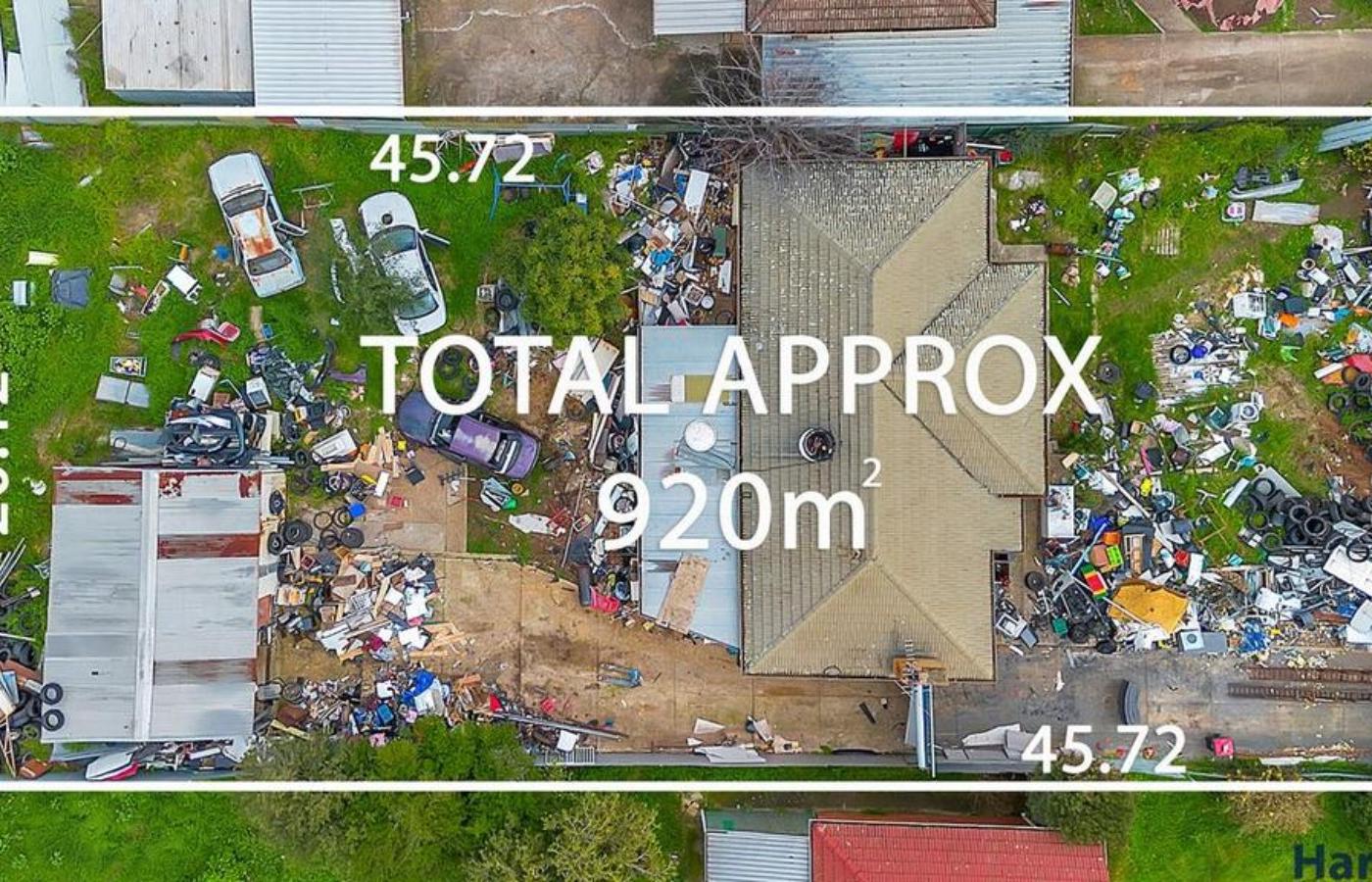
There are no interior photographs. There is no carefully staged living room, renovated kitchen or aspirational lifestyle pitch.
There are, however, at least three abandoned car bodies, dozens of tyres, piles of scrap metal and enough rubbish to make the clean up alone potentially worth $20,000.
Yet within days of being listed, two developers were reportedly already circling.
The property at 16 Midway Road, Elizabeth East, is being marketed by Harcourts Barossa agent Roy Laird ahead of its 29 August auction.
The three bedroom brick home is considered uninhabitable, with Laird telling Adelaide Now that demolition is the only realistic option for whoever buys it.
His assessment of the property was refreshingly direct.
It is, in his words, “rough as guts”.
That may also be the most effective property marketing line of the week.
The campaign makes little attempt to dress the property up as a renovation opportunity. Its value rests almost entirely in the 920sqm parcel of land, which has a 20.1 metre frontage and an easement.
The price guide of $600,000 reportedly reflects the underlying land value rather than the condition of the existing house.
Laird expects developers to make up most, if not all, of the serious buyer pool. He believes the site could potentially accommodate three single level homes, although he has seen developments containing as many as five dwellings on similarly sized blocks.
Any redevelopment would remain subject to council approval.
The property is also positioned near schools, shops, public transport, Fremont Park and the Lyell McEwin Hospital, strengthening its potential as a redevelopment site.
For Australian real estate agents, the campaign provides a useful lesson in knowing exactly what is being sold.
Sometimes the house is the product.
Sometimes it is the problem.
Agents are regularly encouraged to polish listings, control the visual presentation and find the most attractive language available. But there comes a point where euphemisms such as “renovator’s delight” or “a blank canvas” can begin working against the campaign.
Buyers know what they are looking at.
Developers certainly do.
In this case, eliminating the lifestyle language and presenting the property as a land and redevelopment opportunity may help qualify buyers before they enquire. It prevents prospective purchasers from arriving with unrealistic expectations and allows the agent to concentrate on the small group capable of seeing value beneath the rubbish.
The absence of interior photographs could ordinarily raise questions about what a campaign is attempting to conceal. Here, the property’s condition is central to the story, and Laird’s public comments leave little room for misunderstanding.
That bluntness may be why the listing has attracted attention beyond the usual development audience.
Records show the property sold for $225,000 in December 2009. At the time, it was promoted as having an updated kitchen and bathroom, a spacious lounge and a rear verandah.
Its deterioration since then is significant, although the reasons behind its current condition have not been publicly disclosed.
What has endured is the land.
At a time when housing supply remains under pressure, a site capable of accommodating several new homes can carry substantial value even when the existing dwelling has reached the end of its useful life.
That is the practical business story behind the spectacle.
A listing does not always need beautiful photography, flawless styling or an elaborate emotional narrative. It needs to identify the genuine buyer, communicate the opportunity clearly and remove uncertainty wherever possible.
The house at 16 Midway Road may be beyond saving.
The campaign’s honesty could be exactly what saves the sale.

This article was independently written and edited by Real Estate Today. © Real Estate Today 2026 – All Rights Reserved.
Real Estate Today is an independent real estate industry publication covering Australia and New Zealand.

THE-RET experience

The Morning Brief
The essential real estate briefing with Jake & Mia.
From 5:30am every weekday.

The 7:30 Report
The day's property news, context and what comes next with Dan & Sarah.
Five nights a week.





Trending
ActivePipe by MoxiWorks Joins Real Estate Today as Major Partner
Industry News
Three heavyweights, one network: Eastern suburbs rivalry heats up
Industry News
The Truth Hurts, But Read This Anyway
Network News
Harcourts Solutions Golf Day raises $13,000 for Mitchelton Special School
Community
What Actually Makes a Healthy Real Estate Office? The Numbers Beyond GCI
Opinion